Dedicated to our Pujya Gurudev Swami Chinmayananda

Dedicated to our Pujya Gurudev Swami Chinmayananda

Hari OM!

This blog is designed to serve as a library of art and craft ideas for our balavihar children. We hope that you will find this site useful. Please feel free to use any (or all) of the projects you see posted here. We ask, however, that you refrain from publishing (in any form) these templates, instructions, and photographs, unless you receive written permission. These projects are being provided for your own personal use or use in the Balavihar classroom.


All art projects are categorized by 1) material, 2) use, and 3) type. For example a Diya greeting card would be under the labels "Paper" and "Cards," while a Lord Hanumaan puppet would be found under "Paper," "Toys and Puppets" and "Gods and Goddesses." Most materials for these projects can easily be purchased from any local craft store — and some projects involve materials you already have laying around the house.


We would love to hear your suggestions and ideas about any of the information you find on this site. And, if you have any projects that you would like to share with other seviks/sevikas, please send a picture of the finished piece, as well as instructions on how to make the project – so we can post it.


Happy Creating!

Showing posts with label Summer Camp. Show all posts

Friday, June 11, 2010

Shiva Lingam Mandala (Likhita Japa)


This mandala is dedicated to Guruji
Summer Camp 2010


Click on the image to view enlarged.

This mandala was created with likhita japa of "ऊँ नमः शिवाय" (OM namah Shivaaya.) Lightly trace the inner and outer circles with a pencil and bowl (or circle templates) . Once you are satisfied with the proportions, begin the likhita japa session with your writing pens. All pencil lines should be gently erased after the ink has thoroughly dried. The Shiva Lingam was painted (with gouache) in the center as a point of reflection after the japa session was completed.

Materials
• Good quality writing pens with different nib sizes
• Good quality Bristol paper (smooth vellum surface)
• Pencil
• Graphic eraser
• Gouache paints
• Paint brushes
• Gold metallic calligraphy pen/ink

Wednesday, June 2, 2010

OM Likhita Japa


Click on image to view enlarged

This likhita japa was created from doodling patterns (see previous posting in May archive.) The entire mandala was designed with variations on OM.

Materials Needed:
• A smooth surface paper
• Pens of different sizes
• Bowls (or compass) for tracing circle outline
• Pencil
• Quality graphic eraser

Lightly sketch the outline design with a pencil — your details will emerge from the japa. Do not sketch the writing in ... that should be performed in ink when you begin your session. Gently erase all pencil lines only when you are completely finished with the likhita.

Experiment with color, too!

Thursday, May 20, 2010

Peacock Feather Likhita Japa


This likhita japa is dedicated to Swamiji
Summer Camp 2010


Click on the image to view enlarged.
The feather outline was lightly sketched in pencil before the japa began. With the outline in place, one can completely focus on writing the mantra without getting distracted by composition or placement. When the likhita japa session is completely finished (and the ink is dry), then the pencil lines can be gently erased.

For summer camp 2010 we will be encouraging the older children to perform likhita japa with their color and composition studies.

Monday, May 17, 2010

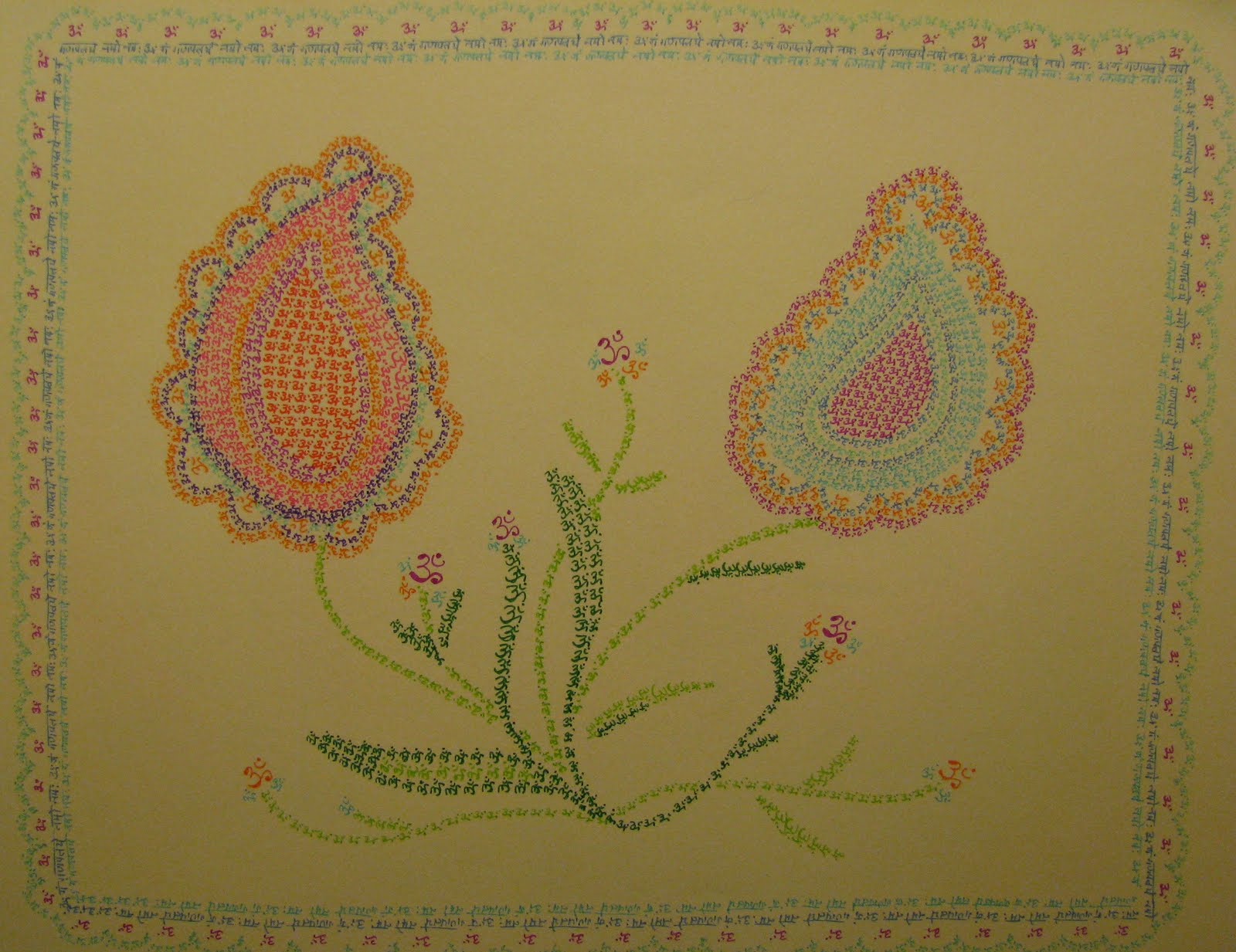
Paisley Flowers in Likhita Japa


This likhita japa is dedicated to Guruji.
Summer Camp 2010

Click on image to view enlarged.

These flowers were created solely from OM. The picture outline was lightly sketched in pencil before the japa began. With the outline in place, one can completely focus on writing the mantra without getting distracted by composition or placement. When the likhita japa session is completely finished (and the ink is dry), then the pencil lines can be gently erased.

For summer camp 2010 we will be encouraging the older children to perform likhita japa with their color and composition studies.

Tuesday, May 4, 2010

Likhita Japa Drawing (Lord Ganesha)


This drawing is dedicated to Guruji
Summer Camp 2010

Click on the image to view enlarged.

Here is a sample of a Likhita Japa Drawing. A very light pencil sketch was done outlining Lord Ganesha before the likhita japa session began. The outline was put in only to help guide the japa, so that focus would not be lost. Once the likhita was completely finished (and the ink was dry) the pencil lines were erased with a graphic eraser.

Materials
• bristol drawing paper
• black pens in different widths
• a pencil
• a good graphic eraser.

Some suggestions of images for the older children to try:

• a Shivalingam
• a diya
• a lotus flower
• a Rangoli pattern

Likhita Japa Doodling


Summer Camp 2010
Click on the image to view enlarged

Doodling is an all-time favorite calming activity — especially for older school children. Why not encourage them to doodle while doing likhita japa?

Here are two sample pages of "japa doodle drawing." The only materials necessary for doodling is a smooth piece of drawing paper, pencil, graphic eraser and a black pen in 3 different widths — thick, fine and super/extra fine. Tell the child to let their pen go where the japa takes them!

Likhita Japa Doodle Drawing


Summer Camp 2010
Click on the image to view enlarged.

These drawings are nothing more than big doodles. Once the older children are comfortable with the idea of writing in different directions you can guide them towards a larger doodle.

Directions
1. Take a bowl and lightly trace it (with a pencil) in the center of the page.
2. Have the child then take their pencil and divide up the circle, creating shapes. They can even extend the shape outside the circle.
3. Begin drawing with ink!

Materials
• smooth surface drawing paper (bristol is an excellent choice)
• pencil
• a good graphic eraser
• black pens in different widths (thick, medium, fine and extra fine)

When the drawing is complete and the ink is dry, then the child can carefully erase the pencil lines. Please encourage the child to not draw any details with the pencil — they should only make light outlines of general areas. The detail work should be done with the likhita japa.

Thursday, April 8, 2010

Likhita Japa


Summer Camp 2010

Here are some samples of likhita japa that have been written in color ink. It is recommended that the children begin with simple shapes and just a few colors (no more than three.) All shapes and colors should be decided upon before likhita japa begins — they don't want to be making decisions while writing.

It is also important to tell the children that there are no mistakes in likhita japa. They are to forget all the rules they learned about writing on a straight line (or coloring inside the lines) — this is the child's personal journal and they should be free to explore this process any way they choose. If they decide to write in one corner of the page, leaving the rest of the page blank — that is perfectly fine! These pages are not being exhibited at a National Art Gallery, so please don't judge their work. The goal is to encourage the child to connect with their mantra and enjoy the process — it makes no difference whether they write in a linear mode or just plain doodle.

The erasers are to be put away before the writing session begins. No one should be allowed to touch an eraser during likhita japa. All pencil markings can be removed after the japa session has ended.

Here's a  good first exercise:  Try using color as a way to refocus the mind by having the children begin writing with one color. Tell them that once their mind begins to wander, they should put down their pen and pick up another color. Continue writing and repeat this process until the japa session is finished. When they are done, have the children spend a few minutes reflecting on their writing —making sure to count how many times their thoughts left the page. It's fun to try and do this regularly until everyone ends up with only one color. An agreed amount of time for the japa session should be decided on — you can set a timer to let everyone know when the session is over.  As the child's ability to focus strengthens, increase the time.

Materials Needed
• Regular color writing pens. (Fine and medium points are good.)
• Sketchbook or drawing paper with a smooth surface.
• A pencil and good eraser

Directions
1. If the child wants to do circular likhita japa, trace a bowl onto the center of the page. (He/she can also lightly sketch out any other geometric shapes to write into. Make sure, however, that the shapes are basic outlines — there should be no details drawn with the pencil.)

2. Have the child work from the outside of a shape (or the page) to the center.

To view any of the photographs enlarged, just click on the picture.

Summer Camp 2010 – Week 1
Photographs are copyrighted. 2010


Wednesday, April 7, 2010

Color Study


Summer Camp 2010

This is a very simple lesson in creating a color wheel using the three primaries: red, blue and yellow. Check out the following sites for some great information on the basics of primary, secondary, tertiary, complimentary and analogous colors:

Arty Factory (click here to view)
Middle School Color Theory Projects (click here to view)
Lesson Plans Page (click here to view)

To make an easy, no mess, color wheel you will need:

• Red, Blue and Yellow water-soluble color pencils (We used Caran'dache supracolor — carmine red, sapphire blue and yellow to make the samples shown.)
• a small dish of water
• a paintbrush
• water color paper


Orange = Equal portions of Red and Yellow
Purple = Equal portions of Red and Blue
Green = Equal portions of Blue and Yellow
Black (for our purposes)  = Equal portions of Red, Blue and Yellow


Helpful Hints:

• To create a consistent paint blending we laid down the lighter color first, with the darker on top.

• After all the colors have been drawn with the pencil, lightly brush water onto the circles. Like magic you will see a watercolor painting emerge.

• After completing a color wheel, have the children try sketching out a grid of squares. Then with their three pencils, create paintings incorporating all the color combinations they learned with their wheel. (Try some with only secondary colors, some with one primary and 2 secondary, 2 complimentaries, etc. There are many variations on this theme — let them have some fun exploring!)

• If you want the children to understand tints and shades of colors, you can give them a White pencil to mix with. (Tints are the hues (colors) with white added. Shades are the hues with black added.




Friday, January 8, 2010

Lord Ganesha Pop-Up Card

This project is dedicated to Gurudev
©jmg 2008 For personal use only
Summer Camp 2009, 2010
Click on picture to view enlarged.

This card is not difficult to make at all – don't be discouraged by the number of assembly steps listed below.  Balavihar summer camp students (of all ages) made oodles of these. Adult supervision, however, is needed for cutting with an exacto knife.

Materials
• 1 Cream color greeting card (and envelope) 5 x 7*
• 1 Cream colored card (for pop-up structure) 4 1/4 x 5 1/2*
• Light color cardstock (for printing template image below)
• Gold foil
• Glue stick
• Scissors
• Exacto knife (adult supervision)
• Rhinestones, sequins, etc. (for decorating Lord Ganesha's crown)
• Gold gel pen
• Markers or colored pencils

* Fold a piece of sturdy cardstock for the card. Cut size to measurements listed above.

Directions
1. Print the image (below) onto a light colored cardstock.

2. Cut out the head, ears and pop-up template.

3. Fold the ears and head on the lines where indicated (dotted lines.)

4. With the 4 1/4" x 5 1/2" card stock (in the folded position) , place the pop-up template on top. Make sure to carefully line the template onto the fold of the card.)

5. Trace the solid lines onto the folded cardstock. These lines determine the crown and head of Lord Ganesha.

6. With a pair of scissors, cut on the solid lines. Do not cut on the dotted lines.

7. Once you have made your cuts, fold the two shapes on the dotted lines. The top shape is the crown, and the bottom shape is Lord Ganesha's head.

Open the card and push the shapes in. Click here to see how it is done with a traditional pop-up card.

8. With the exacto knife (and adult supervision) you will be making 3 slices into the folded cardstock:

a)  The first two will be vertical cuts on either side of Ganesha's head — these cuts are where the ears will be placed. Make sure that your cuts will be long enough to insert each ear into.

b) The next cut will be horizontal, positioned about 1/5 to 1/4  down from the top of his face. This cut is where the trunk goes.

9. Once you have your cuts made, insert the ears and the trunk. Make sure to securely glue each flap on the back side of the card.

10. The trunk will create a natural fold when you close the card for the first time. Once the trunk has been folded, you can glue the tip of the trunk to the inside paper where it touches when the card is in the closed position.

11. Now you are ready to glue the inside folded card (4 1/4 x 5 1/2) to the outside card (5 x 7). Position the pop-up card inside the larger folded card, making sure that it is centered nicely. Open one side of the outer card and glue the inner card. Make sure to not glue the cut out areas, otherwise your card will not pop-up. Gently lay the outer card down on the inner card and rub thoroughly with your hands. Turn the card over and do the same to the other side. Click here to see pictures of gluing the folded papers together.

12. Decorate your Lord Ganesha — and then make another!


Solid lines represent cutting lines.
Dotted lines represent fold lines.


Click for full-page view. Print on cream colored cardstock

Sunday, September 20, 2009

Mosaics with Paper

© 2008 This project is dedicated to Gurudev.
For use in Balavihar classrooms (or personal use) only.
© 2008 This project is dedicated to Gurudev.
For use in Balavihar classrooms (or personal use) only.
Click on image to view enlarged.

Summer Camp 2010
This is a really fun and simple project to do, with any kind of paper - wrapping, artist decorative, scrapbooking, magazine photos, or even plain construction. (Here is a good justification for saving scraps from around the house.) We like to use decorative and scrapbooking because it adds interesting texture and patterning. Before doing a Rangoli picture, we suggest that you start with a basic square grid pattern, so that the children can begin to understand how colors and patterns relate to and effect one another.

Materials
Base paper. Light colored cardstock is recommended.
Variety of paper scraps (cut into 1 or 2 inch squares)
Glue stick
Scissors
Pencil
Ruler

Directions
With a pencil and ruler, lightly draw and 1 (or 2 inch) square grid on the surface paper. Arrange your paper squares and glue.

Note: Once the child has mastered the art of arranging and gluing, have him/her experiment with rangoli designs. You can cut a square into triangles, for instance, to create a more complicated pattern. The possibilities are endless!

Color Wheel (in clay)

© 2008 This project is dedicated to Gurudev.
For use in Balavihar classrooms (or personal use) only.
Click on image to view enlarged.
Summer Camp 2010

All colors blended together equal कृष्ण

Materials
Clay - Red, Blue, Yellow and White (Crayola Modeling Magic works nicely)
Clay roller or chapati roller

Directions
1. Take a ball of white clay and roll it out like a chapati. Try to make it as round as possible.
2. Give each child equal portions of red, blue and yellow clay.
3. Have them divide each color into four equal portions. You should end up with four small balls of blue, red and yellow.

At this point, it's really helpful to place the colors - as you make them - around the outside of the white "chapati". Otherwise, you'll get confused as to which color belongs where. Don't press them into the wheel until you're completely done mixing all of the color discs -- this will be the very last thing you do.

4. Following the diagram below, place one of the red balls on the outside of the wheel. Do the same with one blue and yellow ball. (These are the primary colors.)
5. Take a red, blue and yellow ball and divide each of them into halves. (You should have two equal portions of each color.)
6. Take a red, blue and yellow balls and divide each of the colors into four equal little balls. (You should have 4 equal portions of each color.)

* You will have a ball of red, blue and yellow left over. Set these aside for the center of the wheel.

7. With the balls from Step 5, thoroughly blend numbers 2, 5, and 8 on the diagram below. Place them on the outside of the wheel. (These are the secondary colors.)
8. With the little balls from Step 6, blend numbers, blend numbers 1, 3, 4, 6, 7 and 9 on the diagram below. Place them on the outside of the wheel. (These are the tertiary colors.)
9. Blend the remaining portions of red, blue and yellow. This goes in the center of the wheel. This is कृष्ण - all colors (or black.)
10. Now that you have all your colors mixed, place the color discs (one by one) onto the surface and press into the wheel.

Mouse Sponge Art

© 2009 This project is dedicated to Gurudev.
For use in Balavihar classrooms (or personal use) only.
Click on image to view enlarged.

Summer Camp 2010

मूषकः
(muuShakaH)

मूषकस्य कर्णौ बृहतौ स्तः।
muuShakasya karNau bRihatau staH.
The mouse's ears are big.

मूषकः लघुः अस्ति।
muuShakaH laghuH asti.
The mouse is small.


This is page one of a child's Sanskrit Animal picture book. Click here to see a sample of an assembled book.

Materials
• Sponge (cut into oval shape, any size will do)
• Paper, cardstock (Make sure that it is a size proportional to your sponge size. 4 x 4 inch squares work well.)
• Medium black marker or gel pen. (.o7 mm)
• Gray tempera paint (We like to mix white and black together, keeping some streaks of white and black in the mixture -- this gives the print more depth and makes the overall image seem more painterly.

Directions
1. Spread a very thin layer of tempera paint onto a paper plate and dip the sponge into it. (Don't worry if the entire sponge is not covered with paint -- the result looks lovely when there are shades of gray and unevenness in paint.)

2. Print your sponge onto the center of the paper.

3. Take your black pen and draw the lines to define your mouse. (Coloring in the shapes can add yet another dimension to the image.) Feel free to copy the picture above or make up your own drawing!

Turtle Sponge Art


© 2009 This project is dedicated to Gurudev.
For use in Balavihar classrooms (or personal use) only.
Click on image to view enlarged.
Summer Camp 2010

कूर्मः
(kuurmaH)


कूर्म: मन्दं चलति।
kuurmaH mandam chalati.
The turtle walks slow.


This is page two of a child's Sanskrit Animal picture book. Click here to see a sample of an assembled book.

Materials
• Sponge (cut into oval shape, any size will do)
• Paper, cardstock (Make sure that it is a size proportional to your sponge size. 4 x 4 inch squares work well.)
• Medium black marker or gel pen. (.o7 mm)
• Gray tempera paint (We like to mix white and black together, keeping some streaks of white and black in the mixture -- this gives the print more depth and makes the overall image seem more painterly.

Directions
1. Spread a very thin layer of tempera paint onto a paper plate and dip the sponge into it. (Don't worry if the entire sponge is not covered with paint -- the result looks lovely when there are shades of gray and unevenness in paint.)

2. Print your sponge onto the center of the paper.

3. Take your black pen and draw the lines to define your turtle. (Coloring in the shapes can add yet another dimension to the image.) Feel free to copy the picture above or make up your own drawing!

Fish Sponge Art


© 2009 This project is dedicated to Gurudev.

For use in Balavihar classrooms (or personal use) only.
Click on image to view enlarged.
Summer Camp 2010

मत्स्यः
(matsyaH)

मत्स्यः तरति।
matsyaH tarati.
The fish swims.


This is page three of a child's Sanskrit Animal picture book. Click here to see a sample of an assembled book. 

Materials
• Sponge (cut into oval shape, any size will do)
• Paper, cardstock (Make sure that it is a size proportional to your sponge size. 4 x 4 inch squares work well.)
• Medium black marker or gel pen. (.o7 mm)
• Gray tempera paint (We like to mix white and black together, keeping some streaks of white and black in the mixture -- this gives the print more depth and makes the overall image seem more painterly.

Directions
1. Spread a very thin layer of tempera paint onto a paper plate and dip the sponge into it. (Don't worry if the entire sponge is not covered with paint -- the result looks lovely when there are shades of gray and unevenness in paint.)

2. Print your sponge onto the center of the paper.

3. Take your black pen and draw the lines to define your fish. (Coloring in the shapes can add yet another dimension to the image.) Feel free to copy the picture above or make up your own drawing!

Spider Sponge Art


© 2009 This project is dedicated to Gurudev.

For use in Balavihar classrooms (or personal use) only.
Click on image to view enlarged.
Summer Camp 2010

तन्तुनाभः
(tantunaabhaH)

तन्तुनाभः उपरि गच्छति।
tantunaabaH upari gacchati.
The spider goes up.


This is page four of a child's Sanskrit Animal picture book. Click here to see a sample of an assembled book. 

Materials
• Sponge (cut into oval shape, any size will do)
• Paper, cardstock (Make sure that it is a size proportional to your sponge size. 4 x 4 inch squares work well.)
• Medium black marker or gel pen. (.o7 mm)
• Gray tempera paint (We like to mix white and black together, keeping some streaks of white and black in the mixture -- this gives the print more depth and makes the overall image seem more painterly.

Directions
1. Spread a very thin layer of tempera paint onto a paper plate and dip the sponge into it. (Don't worry if the entire sponge is not covered with paint -- the result looks lovely when there are shades of gray and unevenness in paint.)

2. Print your sponge onto the center of the paper.

3. Take your black pen and draw the lines to define your spider. You may copy the picture above or make up your own drawing!

Bird Sponge Art


© 2009 This project is dedicated to Gurudev. For use in Balavihar classrooms (or personal use) only.
Click on image to view enlarged.
Summer Camp 2010

खगः
(khagaH)


खगः उड्डयते।
khagaH uDDayate.
The bird flies.


This is page five of a child's Sanskrit Animal picture book. Click here to see a sample of an assembled book. 

Materials
• Sponge (cut into oval shape, any size will do)
• Paper, cardstock (Make sure that it is a size proportional to your sponge size. 4 x 4 inch squares work well.)
• Medium black marker or gel pen. (.o7 mm)
• Gray tempera paint (We like to mix white and black together, keeping some streaks of white and black in the mixture -- this gives the print more depth and makes the overall image seem more painterly.

Directions
1. Spread a very thin layer of tempera paint onto a paper plate and dip the sponge into it. (Don't worry if the entire sponge is not covered with paint -- the result looks lovely when there are shades of gray and unevenness in paint.)

2. Print your sponge onto the center of the paper.

3. Take your black pen and draw the lines to define your bird. (Coloring in the shapes can add yet another dimension to the image.) Feel free to copy the picture above or make up your own drawing!

Lion Sponge Art


© 2009 This project is dedicated to Gurudev.

For use in Balavihar classrooms (or personal use) only.

Summer Camp 2010
Click on image to view enlarged.

सिंहः
(simahaH)

सिंहः गर्जति।
simhaH garjati.
The lion roars.


This is page six of a child's Sanskrit Animal picture book. Click here to see a sample of an assembled book. 

Materials
• Sponge (cut into oval shape, any size will do)
• Paper, cardstock (Make sure that it is a size proportional to your sponge size. 4 x 4 inch squares work well.)
• Medium black marker or gel pen. (.o7 mm)
• Gray tempera paint (We like to mix white and black together, keeping some streaks of white and black in the mixture -- this gives the print more depth and makes the overall image seem more painterly.

Directions
1. Spread a very thin layer of tempera paint onto a paper plate and dip the sponge into it. (Don't worry if the entire sponge is not covered with paint -- the result looks lovely when there are shades of gray and unevenness in paint.)

2. Print your sponge onto the center of the paper.

3. Take your black pen and draw the lines to define your lion. (Coloring in the shapes can add yet another dimension to the image.) Feel free to copy the picture above or make up your own drawing!

Bee Sponge Art

© 2009 This project is dedicated to Gurudev.
For use in Balavihar classrooms (or personal use) only.

Summer Camp 2010
Click on image to view enlarged.

मधुमक्षिका
(madhumakshikaa)


मधुमक्षिका पुष्पम् इच्छति।
madhumakShikaa puShpam icChati.
The honeybee wants a flower.

मधुमक्षिका पुष्पम् अन्विष्यति।
madhumakShikaa puShpam anviShyati.
The honeybee looks for a flower.


This is page seven of a child's Sanskrit Animal picture book. Click here to see a sample of an assembled book.

Materials
• Sponge (cut into oval shape, any size will do)
• Paper, cardstock (Make sure that it is a size proportional to your sponge size. 4 x 4 inch squares work well.)
• Medium black marker or gel pen. (.o7 mm)
• Gray tempera paint (We like to mix white and black together, keeping some streaks of white and black in the mixture -- this gives the print more depth and makes the overall image seem more painterly.

Directions
1. Spread a very thin layer of tempera paint onto a paper plate and dip the sponge into it. (Don't worry if the entire sponge is not covered with paint -- the result looks lovely when there are shades of gray and unevenness in paint.)

2. Print your sponge onto the center of the paper.

3. Take your black pen and draw the lines to define your bee. (Coloring in the shapes can add yet another dimension to the image.) Feel free to copy the picture above or make up your own drawing!

Owl Sponge Art


© 2009 This project is dedicated to Gurudev.

For use in Balavihar classrooms (or personal use) only.

Summer Camp 2010
Click on image to view enlarged.

उलूकः
(uluukaH)


उलूकः उत्तिष्ठति।
uluukaH uttiShThati.
The owl stands.

उलूकस्य नेत्रे बृहतौ स्तः
uluukasya netre bRihatau staH.
The owl's eyes are big.


This is page eight of a child's Sanskrit Animal picture book. Click here to see a sample of an assembled book.

Materials
• Sponge (cut into oval shape, any size will do)
• Paper, cardstock (Make sure that it is a size proportional to your sponge size. 4 x 4 inch squares work well.)
• Medium black marker or gel pen. (.o7 mm)
• Gray tempera paint (We like to mix white and black together, keeping some streaks of white and black in the mixture -- this gives the print more depth and makes the overall image seem more painterly.

Directions
1. Spread a very thin layer of tempera paint onto a paper plate and dip the sponge into it. (Don't worry if the entire sponge is not covered with paint -- the result looks lovely when there are shades of gray and unevenness in paint.)

2. Print your sponge onto the center of the paper.

3. Take your black pen and draw the lines to define your owl. (Coloring in the shapes can add yet another dimension to the image.) Feel free to copy the picture above or make up your own drawing!